Groundwater extraction affects hydrological process over Beijing-Tianjin-Hebei region in Northern China
['groundwater', 'extraction', 'study', 'water', 'Beijing-Tianjin-Hebei']
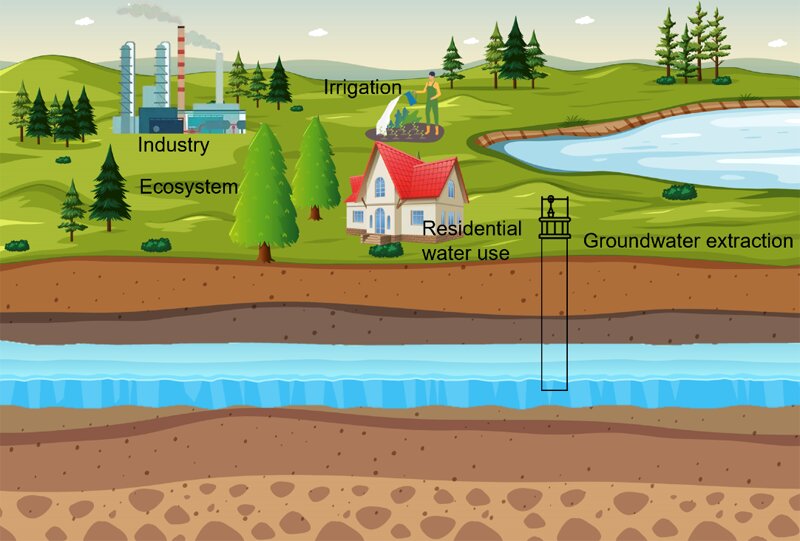
The rapid development of agriculture and industry in the Beijing-Tianjin-Hebei region leads to an increase in water demand. Excessive groundwater extraction often results in the water depletion that may affect ecological and hydrological processes.
Groundwater extraction affects hydrological process over Beijing-Tianjin-Hebei region in Northern China
Excessive groundwater extraction often results in the water depletion that may affect ecological and hydrological processes. Recently, a joint research team led by researchers from the Institute of Atmospheric Physics of the Chinese Academy of Sciences investigated the effects of groundwater extraction on hydrological process and energy cycle in Beijing-Tianjin-Hebei by high resolution simulations. "Human groundwater extraction deepened the groundwater table depth between 2000 and 2012 across the plains in front of Taihang Mountain," said Prof. Jia Binghao, the corresponding author of the study. According to this study, groundwater extraction rapidly reduced terrestrial water storage from 2000 to 2012. "The model in this study can be used for other groundwater extraction hotspots around the world, such as Europe, southern Iran, central United States, northern India, and Pakistan to study the impact of human water use," said Prof. Xie Zhenghui, one co-author of the study. More information: Longhuan Wang et al, Impact of groundwater extraction on hydrological process over the Beijing-Tianjin-Hebei region, China, Journal of Hydrology. Citation: Groundwater extraction affects hydrological process over Beijing-Tianjin-Hebei region in Northern China retrieved 26 April 2022 from https://phys. org/news/2022-04-groundwater-affects-hydrological-beijing-tianjin-hebei-region.